Calculate what one control room event really costs | Try our free ROI calculator


In a control room, the three levels of situational awareness are the difference between catching a developing fault and explaining a cascading outage after the fact.
May 29, 2026

The three levels of situational awareness are perception, comprehension, and projection. Perception is seeing what is happening, comprehension is understanding what it means, and projection is anticipating what comes next.
The model comes from human factors researcher Mica Endsley, and it describes how an operator turns raw data into a decision. Each level depends on the one before it, so a gap at the bottom collapses everything above it.
In a control room, the three levels of situational awareness are the difference between catching a developing fault and explaining a cascading outage after the fact. Below is what each level means, where each one tends to fail, and what it takes to support all three when the data is moving faster than any operator can track by hand.
Here is the model in one view, mapped to what each level looks like inside a grid control room.
Situational awareness is not a soft skill in grid operations. It is the cognitive work that sits between a wall of data and a correct action, and when it breaks down, the consequences are measured in customers without power.
The 2003 Northeast blackout is a good reference case. The official U.S.-Canada Power System Outage Task Force named inadequate situational awareness as one of four root causes of an event that left roughly 55 million people in the dark.
The levels also fail in a predictable order, which is the most useful thing to know about them. In a foundational study of situational awareness errors, Jones and Endsley found that about 76% of failures traced back to level one, perception, with roughly 20% at comprehension and only about 3% at projection.
In plain terms, most of the time the operator never perceived the critical cue in the first place. The understanding and the forecast never got a chance, because the signal was missing, buried, or unreadable.
That finding should change where a control room invests. Fixing projection tools does little if perception is where the picture is breaking. This is why effective situational awareness software starts at the bottom of the model and works up, rather than adding analytics on top of a perception layer that is already failing.
Each level below builds on the one before it. The point is not to treat them as separate stages an operator marches through, but to understand where awareness can break so you can support it where it actually fails.
Perception is the foundation, and it is also where most failures begin. In a grid control room it means taking in telemetry from SCADA and EMS, alarms, sensor alerts, operator inputs, and weather, then registering which of those signals matter right now.
The obstacle at this level is volume. Modern grid operations generate enormous data at high velocity, and a raw feed does not separate the signal from the noise. When everything is presented with equal weight, the one reading that mattered is no easier to spot than the thousand that did not, which is how perception fails even when the data is on screen.
This is the job GridGuardian, Primate's data aggregation and intelligence engine, is built for. It validates source data, monitors system health, and elevates the signals worth attention so perception starts from a clean, prioritized feed rather than a flood. Get level one right and the two levels above it have something solid to stand on.
Comprehension is where perceived data becomes insight. It answers the question the raw number cannot: is this voltage change a routine fluctuation or the first sign of a fault, and are nearby systems confirming the same story? This level links what an operator sees to what it actually means for the network.
Comprehension depends on seeing related data together rather than in separate windows. Electrical state, spatial context, and operational status have to combine into one coherent picture, because an operator who has to mentally stitch four displays together loses time precisely when an event is unfolding.
The complexity of the grid makes that integration hard to do in the head, especially across large video walls and operator stations.
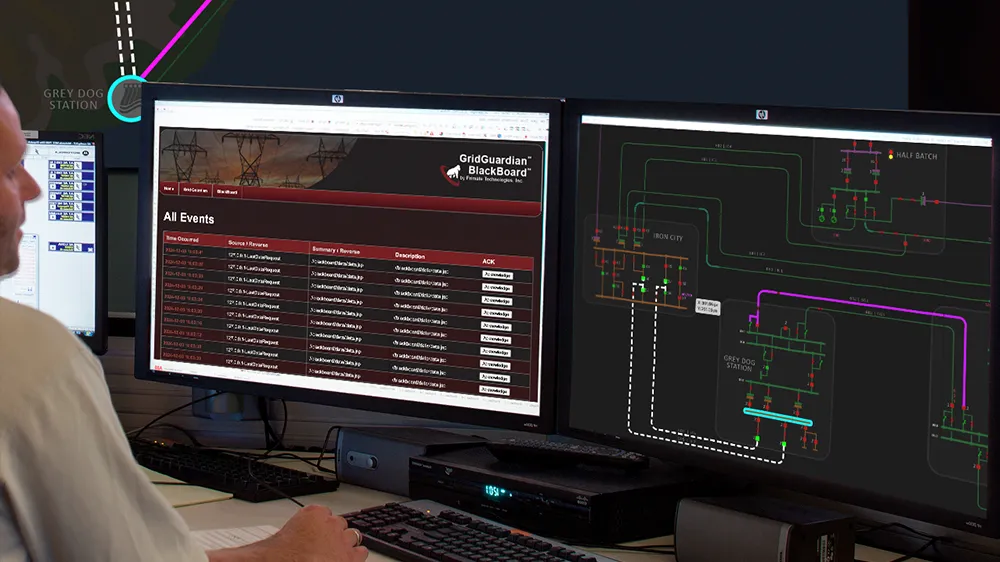
Primate supports this level with BlackBoard and TileViewer, which render everything from schematic one-lines to GIS overlays at high fidelity. Instead of reconciling separate feeds, the operator reads system state, interdependencies, and deviations from a single consolidated view. That is comprehension made fast and reliable rather than left to memory.
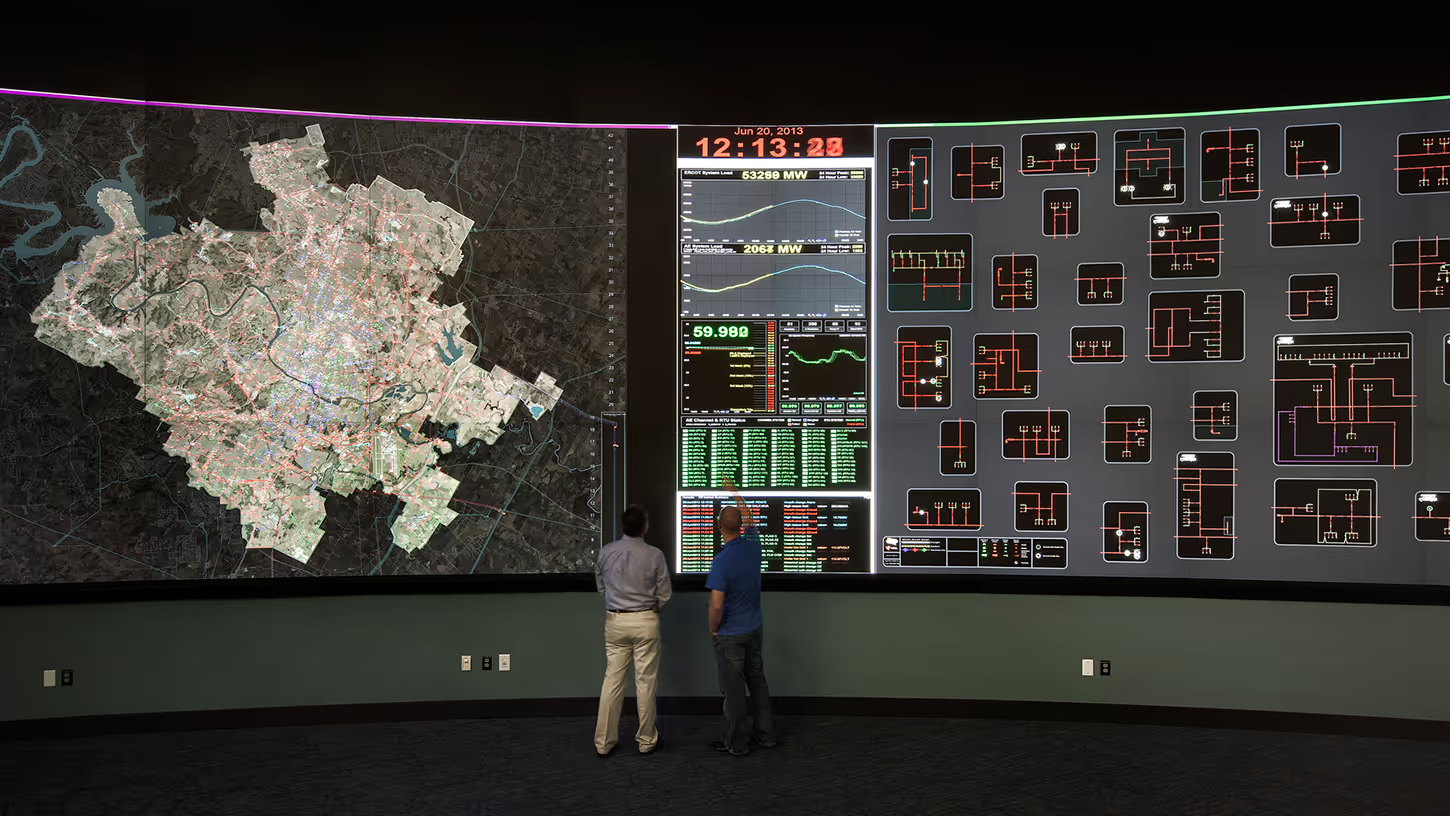
Projection is the highest level, and the rarest to reach under pressure. It is the ability to forecast where the situation is heading, so an operator can act before a problem escalates rather than after. In grid work this is decisive, because a brief delay can be the difference between a contained event and a cascading blackout.
Projection rests on three things working together:
That means that it is not just detecting an anomaly. It is simulating what that anomaly does next, and what each available response would do in turn.
Primate enables this by overlaying real-time data on schematic and geographic displays and pairing it with historian software for the long-term context that turns a present reading into a trajectory.
Anticipating a line overload during a storm, or seeing how an outage might propagate across a region, gives operators the lead time to act early. That is the practical payoff of reaching level three.
The three levels are not a checklist an operator completes once. Instead, they form a loop.
Perception feeds comprehension, comprehension shapes projection, and the actions that follow change the environment. Ultimately, that sends the operator back to perception with a new picture to read. Awareness is only as current as the last pass through that cycle.
What this means for a control room is that you cannot buy awareness one level at a time. A projection tool bolted onto a failing perception layer just produces confident forecasts from incomplete data.
The systems that actually raise situational awareness support the whole loop at once, which is the difference between a stack of disconnected tools and an integrated operational view where perception, comprehension, and projection reinforce each other.
The three levels of situational awareness give grid operators a precise way to think about a vague problem. When response feels slow or an event slips past the team, the question is not whether people are paying attention. It is which level broke, and the data says perception is the usual suspect.
Fix where the picture is actually breaking and the faster response follows.
If your operators are still assembling awareness by hand across disconnected systems, that is the gap worth closing. Request a demo to see how Primate supports perception, comprehension, and projection in one real-time view.
Who created the three levels of situational awareness?
Human factors researcher Mica Endsley introduced the model in 1995. Her three-level framework of perception, comprehension, and projection remains the most widely cited definition of situational awareness across aviation, military, and control room domains.
Which level of situational awareness fails most often?
Level one, perception. Research on situational awareness errors found about 76 percent traced to perception failures, meaning the operator never registered the critical cue, far more than comprehension or projection errors combined.
Is situational awareness the same as monitoring?
No. Monitoring displays data. Situational awareness is the cognitive process of perceiving that data, understanding its meaning, and projecting what happens next. Monitoring supports level one but does not produce the higher levels on its own.
How does software improve situational awareness?
By aggregating data into a prioritized feed, visualizing related systems in one view, and adding historical context for projection. This supports all three levels at once instead of leaving operators to integrate sources manually.
Why is projection the hardest level to reach?
Projection requires holding current understanding, historical patterns, and possible outcomes in mind at once, under time pressure. Without decision support and trend data, operators rarely have the headroom to forecast reliably during an active event.


See if your control room is prepared to support AAR and DLR across visibility, data, and operations.
Check Readiness →.png)