Calculate what one control room event really costs | Try our free ROI calculator


Operational intelligence is the ability to turn raw operational data into real-time, contextual understanding that an operator can act on immediately
May 11, 2026
.jpg)
Operational intelligence is the ability to turn raw operational data into real-time, contextual understanding that an operator can act on immediately. A dashboard shows you numbers. Operational intelligence tells you what those numbers mean for the system you are responsible for, right now, and what is likely to happen next.
That distinction sounds academic until a pump pressure spikes at dawn, the operator on shift has nine screens open, and nobody can say within thirty seconds whether the reading is a sensor glitch or the start of a line failure.
This is the gap most control rooms live inside. They have invested heavily in displays, video walls, and monitoring tools, yet operators still spend their attention stitching together a picture the technology should have assembled for them.
Below is a clear look at how operational intelligence differs from a dashboard, why that difference compounds under pressure, and what a genuine operational intelligence platform does that a wall of charts cannot.
Operational intelligence is the layer that sits between your data and your decisions. It pulls signals from every operational system you run, normalizes them so they speak the same language, correlates related events, and presents the result as something an operator can interpret at a glance. A dashboard is one possible output of that work. It is not the work itself.
The clearest way to understand the difference comes from human factors research. Mica Endsley, former Chief Scientist of the U.S. Air Force, defined situational awareness as three stacked levels:
A dashboard usually delivers the first level. It perceives and displays. Operational intelligence reaches the second and third, because it interprets relationships and anticipates consequences. Endsley's work found that most awareness failures happen at the perception stage, which is exactly where a dashboard stops and leaves the operator to do the rest.
That is why a strong operational intelligence platform is judged less on how many metrics it can show and more on how quickly it produces understanding. Showing data is the easy part. Making meaning out of it, fast enough to act, is the hard part that decides outcomes.
Dashboards are useful. The problem starts when they become the entire strategy for a control room responsible for grid reliability, pipeline safety, or transit operations.
At that scale, a dashboard quietly shifts the cognitive burden back onto the people watching it, and that burden has limits.
A common response to operational complexity is to add another screen. SCADA on one display, GIS on another, the alarm list on a third, and weather on a fourth.
Each tool is accurate in isolation, but the trouble is that the correlation between them lives only in the operator's head. That mental model breaks down precisely when an incident touches several systems at once. Adding displays multiplies the inputs without reducing the work of making sense of them.
This is where the dashboard model and the operational intelligence model diverge. One asks the operator to integrate everything manually. The other does the integration first and shows the operator a unified state.
The second ceiling is alarm volume. When raw signals flow straight to a display without prioritization, operators face floods rather than signals.
Industry guidance from the EEMUA recommends an average of no more than one alarm every ten minutes during normal operations, roughly six an hour, because anything beyond that overwhelms human response. During a real upset, undisciplined systems can blow past that by an order of magnitude in seconds.
A dashboard reports every one of those alarms faithfully. It has no way to know that forty of them share a single root cause. That blindness is how teams miss the one condition that mattered. Because the display did its job. The operator still lost the thread.
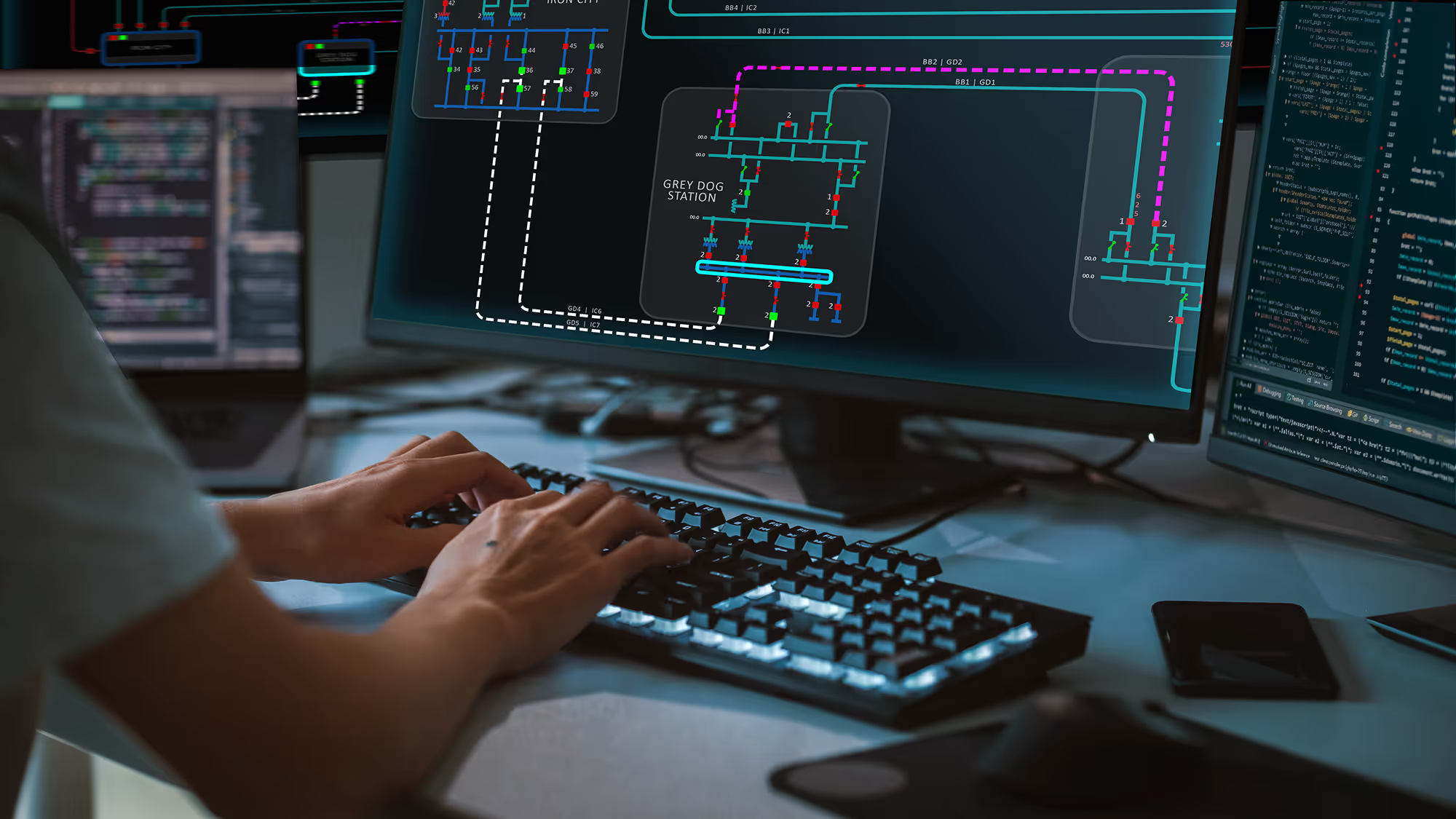
Context is the part dashboards skip. A pressure reading on its own is a number. The same reading becomes a decision when the system knows the upstream valve state, the crew location, the weather moving through the corridor, and whether the trend has been climbing for ten minutes.
None of those facts is useful alone, but together, they tell an operator what to do.
Producing that context requires aggregating and normalizing data from every operational system in real time, which is the core function of Primate's data integration software. Inputs arrive in different formats, on different clocks, with different naming.
GridGuardian, Primate's data aggregation and intelligence engine, consolidates SCADA, OMS, GIS, historian, security, and weather feeds into one normalized stream. Then, it runs custom calculations against them and detects the anomalies worth surfacing. The operator does not see fragments, but a correlated picture with the noise already filtered out.
Consider a gas pipeline scenario.
A dashboard shows a pressure drop on segment 14. An operational intelligence platform shows the pressure drop and flags that a maintenance crew was badged into that segment eleven minutes ago. Then, it overlays the drop against historical baselines for that hour, and finally, it ranks it below an unrelated alarm that is actually trending toward a safety threshold.
The first view describes a symptom. The second tells the operator where to look and in what order.
The value of context becomes obvious in the moments that define a control room. Take grid restoration after a major outage. Black start work depends on bringing systems back in a precise sequence while watching dozens of interdependent conditions.
A dashboard can display each condition, but the operator has to hold the sequence and the dependencies in memory. Operational intelligence holds them in the system, surfaces the next safe action, and flags when a step is out of order before it becomes a setback.
The same logic carries into transportation and transit operations, where a delay on one line ripples into others, and into utility control rooms balancing load against generation in real time.
In each case, the operator's effectiveness depends on comprehension and projection rather than raw perception, which is why Primate's situational awareness software is built to present a normalized operational state instead of a pile of feeds.
The display adapts to the workflow, prioritizes by operational impact, and keeps the picture consistent from a single workstation to a full video wall with no loss of fidelity at scale.
That continuity matters more than it first appears. When the view an operator trusts at their desk is the same view shown on the wall during an incident, the team coordinates faster because everyone is reading one interpretation of reality rather than reconciling several.
Dashboards earned their place by making data visible, and they still have a role. But in mission-critical operations, visibility is the floor, not the goal.
The work that protects uptime and shortens response is the work of turning data into context and context into a decision, and that is what operational intelligence delivers when a dashboard runs out of room.
If your operators are still assembling the picture by hand across disconnected screens, that is exactly the gap worth closing. Request a demo to see how Primate gives your control room one correlated, real-time view.
Is operational intelligence the same as business intelligence?
No. Business intelligence analyzes historical data to guide strategy over weeks or quarters. Operational intelligence works on live data in seconds so operators can respond to conditions as they unfold in the control room.
Can a dashboard provide situational awareness on its own?
Rarely. A dashboard delivers perception, the first level of awareness. Comprehension and projection require correlated context across systems, which a standalone dashboard does not produce without an underlying intelligence layer.
How does operational intelligence reduce alarm fatigue?
It correlates related alarms, suppresses duplicates tied to one root cause, and ranks events by operational impact. Operators then respond to a short list of meaningful signals instead of a continuous flood.
Does Primate sell the displays or video wall hardware?
No. Primate is a software and services company. It aggregates and visualizes operational data across existing displays and video walls, including third-party screens already installed in your control room.
What systems does an operational intelligence platform connect to?
Typically, SCADA, OMS, GIS, EMS, historian platforms, security, and weather feeds. Primate normalizes these disparate sources into one real-time view so operators work from a single, consistent operational state.


See if your control room is prepared to support AAR and DLR across visibility, data, and operations.
Check Readiness →