
Calculate what one control room event really costs | Try our free ROI calculator


SCADA is the system that collects, processes, and controls operational data, while HMI is the interface that lets humans interact with that system. Learn more.
March 30, 2026

If you’re trying to understand the difference between SCADA and HMI, here’s the short answer: SCADA is the system that collects, processes, and controls operational data, while HMI is the interface that lets humans interact with that system.
That sounds simple. In reality, this confusion shows up in almost every control room conversation, especially when teams start scaling operations or modernizing infrastructure. And if you get this wrong, you don’t just mislabel tools, you design the wrong system.
Let’s break it down properly.
In most control rooms, people use SCADA and HMI interchangeably. That’s where problems start.
SCADA and HMI serve completely different roles. One is the brain. The other is the face.
If you treat them as the same thing, you end up with systems that collect massive amounts of data but fail to present it clearly. Or worse, systems that look clean on the surface but lack the depth to support real operational decisions.
In mission-critical environments like utilities, pipelines, and transportation networks, that gap shows up fast. Operators are expected to monitor multiple systems, interpret alarms, and make decisions in seconds.
So the difference directly impacts how well your control room performs under pressure.
SCADA stands for Supervisory Control and Data Acquisition.
At its core, SCADA is responsible for collecting data from field devices, processing it, and enabling supervisory control over infrastructure.
Think power grids, water systems, pipelines, and rail networks. SCADA connects sensors, PLCs, RTUs, and control logic into a centralized system.
According to the U.S. Department of Energy, SCADA systems are essential for monitoring and controlling critical infrastructure in real time, especially in energy and utility environments.
SCADA handles things like:
It’s not visual by default. It’s functional.
SCADA answers the question: What is happening in the system, and what control actions are available?
HMI stands for Human-Machine Interface.
It is the layer operators actually see and interact with. Screens, dashboards, visual diagrams, controls. Everything that translates raw system data into something a human can understand.
An HMI might show pump status, voltage levels, alarms, or flow rates. It might allow an operator to start or stop a process.
According to ISA (International Society of Automation), HMI systems are designed to present complex industrial data in a way that enables fast and accurate human decision-making.
So while SCADA collects and processes data, HMI visualizes it.
HMI answers the question: What does this data mean, and what should I do about it?
Here’s where things get clearer.
SCADA is the system architecture, while HMI is the interface within or on top of that system.
You can have SCADA without a sophisticated HMI, but it will be painful to operate. You can also have a clean-looking HMI that hides weak SCADA logic underneath, which is even worse.
The difference between SCADA and HMI comes down to role:
SCADA manages data and control. HMI presents that data to humans.
But in modern environments, that distinction starts to blur because systems are layered. You may have multiple HMIs connected to one SCADA system. You may have multiple SCADA systems feeding into higher-level visualization platforms.
That’s where most traditional setups start to break.
SCADA systems are built for reliability and control, not for clarity. HMIs are often designed system by system, not as a unified operational view.
So what happens?
This is especially common in utility environments where SCADA, EMS, OMS, GIS, and other systems all run separately.
Even if each system has its own HMI, there is no single source of visual truth.
That’s the gap.
This is where things get interesting.
Modern control rooms are no longer just SCADA plus HMI. There is a third layer that matters more than most teams realize: integrated visualization.
Platforms like Primate don’t replace SCADA or HMI. They sit above them and pull data from multiple systems into a single operational view. Instead of asking operators to interpret five different HMIs, the system aggregates data and presents it in one coherent display.
That includes SCADA feeds, GIS data, weather overlays, outage systems, and more, all rendered in real time across large-format displays or video walls.
This changes how teams operate.
Instead of reacting to individual alarms, operators can see system-wide context instantly. Instead of navigating systems, they focus on decisions.
And that’s where the difference between SCADA and HMI becomes even more important. Because once you understand their roles, you stop trying to force one to do the job of the other.
Let’s take a power grid control room.
SCADA is collecting data from substations, transformers, and transmission lines. It knows voltage levels, load conditions, and breaker states.
HMI displays that data on screens. Operators can see alarms, open diagrams, and issue commands.
Now imagine a storm hits.
SCADA continues to collect data. HMI shows alarms across multiple systems. But the operator still has to piece together what’s happening across the network.
Now introduce a unified visualization layer.
Instead of flipping between HMIs, the operator sees the entire grid, weather patterns, outage zones, and crew locations on one display. Correlated. Contextualized. Actionable.
One of the biggest misconceptions is that HMI is just a feature inside SCADA.
In older systems, that’s often true. But in modern environments, HMI can be independent, distributed, and layered across multiple platforms.
Another misconception is that improving HMI alone solves operational issues.
It doesn’t.
If the underlying SCADA data is fragmented or siloed, a better interface just makes bad data look nicer. The real improvement comes from connecting systems and then visualizing them properly.
The difference between SCADA and HMI is that SCADA runs the system while HMI shows the system.
But neither guarantees clarity.
That’s why modern control rooms are moving toward integrated visualization that connects everything into one operational picture. It reduces cognitive load, speeds up decision-making, and gives operators what they actually need in high-pressure environments.
If you’re serious about improving how your control room operates, start by fixing how your data is seen. Book a demo and see how a unified visualization layer can turn your SCADA and HMI systems into a single, actionable operational view.


See if your control room is prepared to support AAR and DLR across visibility, data, and operations.
Check Readiness →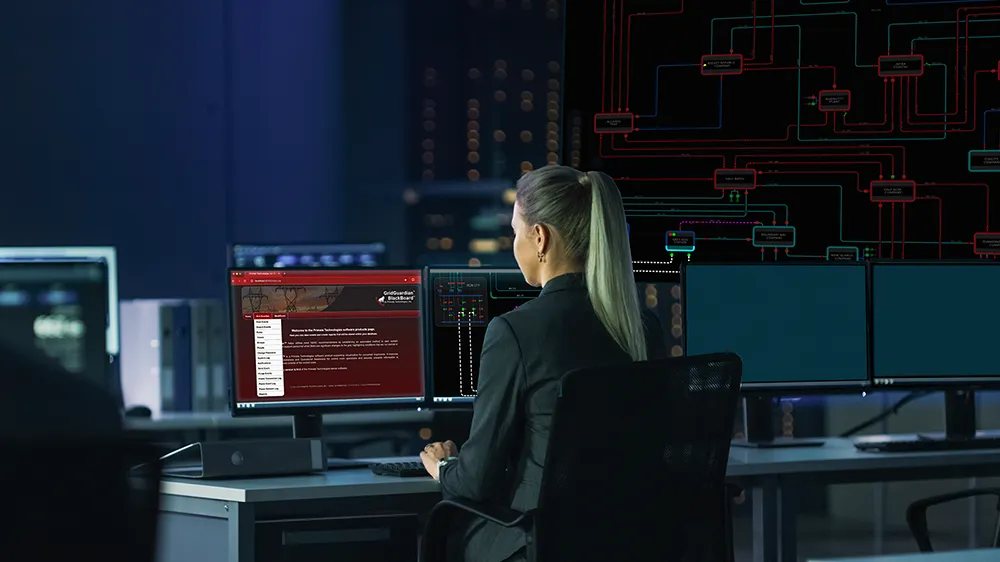
.jpg)