
Calculate what one control room event really costs | Try our free ROI calculator


When a disruption hits a security control room, the operator's job shifts in seconds from watching for trouble to running a live response across every system in front of them. Learn more
June 9, 2026

When a disruption hits a security control room, the operator's job shifts in seconds from watching for trouble to running a live response across every system in front of them. They have to spot the event, confirm whether it is real, understand how its pieces connect, and coordinate a reaction while the situation keeps moving.
What decides the outcome is how much of that work the operator has to do by hand, jumping between separate tools, and how much the room has already assembled for them.
Picture a security operations center for a large facility. One operator is watching a wall of camera feeds, an access control system, an intrusion panel, and a radio channel to officers in the field. For most of the shift, nothing happens, which is its own challenge.
Then three things occur close together.
On three separate systems, these look like three unrelated events. The operator now has to work out whether they are connected.
That means pulling up the gate camera, then switching to the access control log to see whose badge was denied, then scanning back through camera feeds to find the movement, then keying the radio to send an officer.
Each switch takes seconds, and each one pulls the operator's attention off the last system. By the time the picture comes together, several minutes have passed, and the person who triggered the gate alarm is no longer where the camera last showed them.
This is the moment a security control room is built for, and it is also where its design either helps the operator or fights them.
The failure during a disruption is rarely a lack of effort or skill. It comes from three predictable points where the room asks more of the operator's attention than any person can give under pressure. Each one adds time exactly when there is none to spare.
A security control room often presents an operator with dozens of camera feeds at once and expects sustained attention across all of them. Human attention does not work that way for long.
Research on CCTV surveillance describes a measurable drop in detection performance known as the vigilance decrement, which typically sets in after 20 to 35 minutes of continuous monitoring. The operator stays at their post, but their ability to catch a new event quietly declines.
So the first breakdown happens before a disruption is even confirmed. The trigger arrives on a screen that the operator is no longer fully registering, and the response clock starts late. A room that relies on a person to notice everything has already lost time; it will never get back.
Once an event is spotted, confirming it means moving between systems, and that movement carries a cost most control rooms underestimate.
Research on workplace interruptions found that once people are pulled off a task, they rarely return to it directly, typically handling about two other tasks first before getting back to the original work.
In a security control room, that pattern repeats every time the operator jumps from camera to access log to radio.
Each switch leaves a residue of the last system and delays a full grasp of the current one. The operator is busy the entire time, yet the coherent understanding of what is happening keeps slipping a step behind. That’s because the work of stitching the systems together falls entirely on them.
Visibility gaps and context switching add up to the third and most consequential breakdown. The operator does eventually assemble the full picture of the disruption. The trouble is when.
By the time the gate alarm, the badge denial, and the camera movement are understood as one connected event, the event has already developed past the point where the response would have been most effective.
This is the quiet failure mode of a security control room. Nothing looks broken. The cameras worked, the alarms fired, and the logs recorded everything. The operator simply could not converge on the meaning fast enough, because the room handed them fragments and left the correlation as a manual task during the worst possible minutes to be doing it.
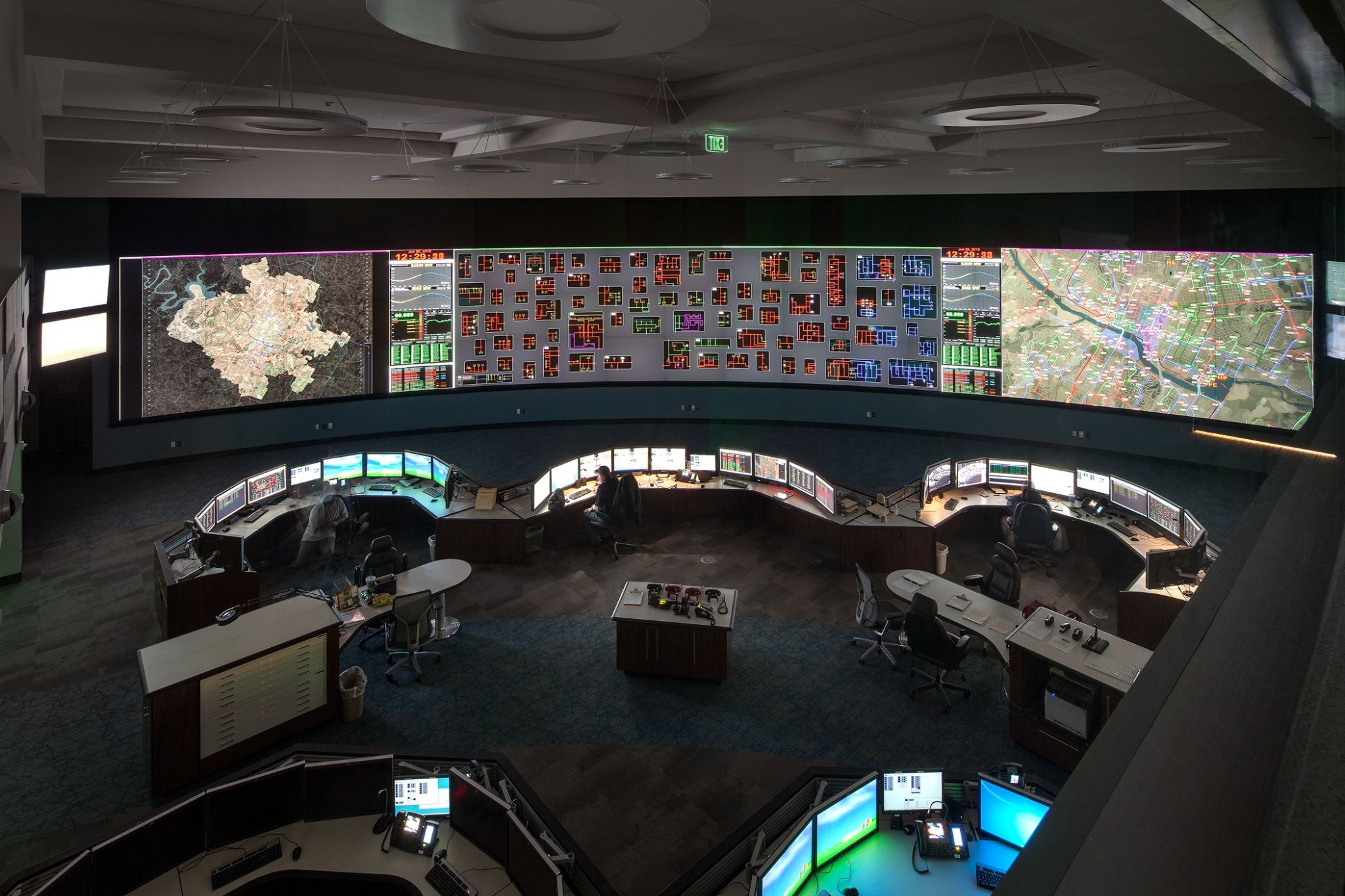
Every one of those breakdowns traces to the same root. The systems in a security control room each work well alone and were never brought into one view.
Fixing that does not mean replacing the cameras, the access control, or the dispatch tools. It means adding a layer above them that aggregates their feeds and presents one real-time picture, so the operator reads the situation instead of reconstructing it.
This is the role Primate plays in a mission-critical control room. Data integration software consolidates separate operational and security feeds into a single normalized stream, so all inputs surface together rather than as three disconnected alerts.
That alone removes most of the context switching the operator would otherwise carry, because the correlation is already done.
From there, situational awareness software renders that stream as a spatial, geographic view of the site, so the operator sees where each event sits and how the pieces relate at a glance. BlackBoard and TileViewer keep that picture consistent from a single workstation to the control room video wall, so when a disruption escalates and a supervisor steps in, everyone is reading the same live state.
The principle reaches well past security. A utility control room, a transit operations center, or any room running on disconnected systems faces the same three breakdowns during a disruption. Integrated, real-time visualization is what answers all three at once, in any control room where minutes decide the outcome.
A security control room is tested not on a quiet shift but in the few minutes of a real disruption, and those minutes expose whatever the room left to the operator.
When detection depends on unbroken attention, confirmation depends on switching between systems, and understanding arrives only after the moment to act, the response is slow by design. Bring the feeds into one correlated view, and that entire design changes.
In 2026, with security teams watching more feeds and facing more complex events, the rooms that respond well are the ones that stop making operators assemble the picture under pressure. If your team is still working on disruptions across separate systems, that is the gap worth closing now. Request a demo and see how.


See if your control room is prepared to support AAR and DLR across visibility, data, and operations.
Check Readiness →
.png)
.png)