Operational Resilience Software

Resilience is not measured on a good day. It is measured the moment a feed drops, a server fails, or a region goes dark. Primate's operational resilience software keeps operators in command of utilities, pipelines, and critical infrastructure through degraded states, partial failures, and full restoration, without losing any context or control. 
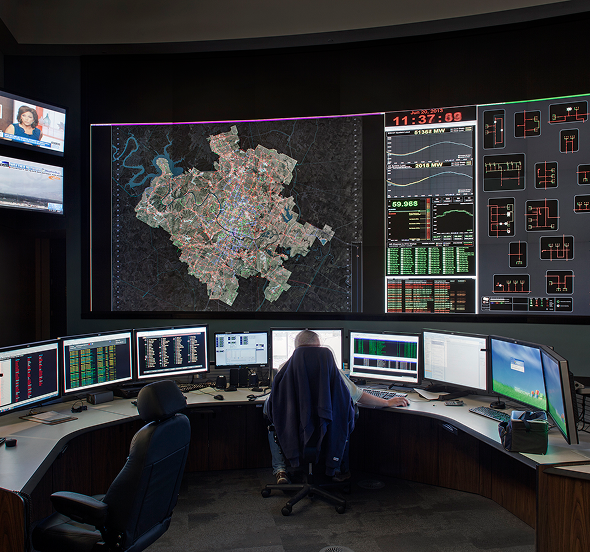
Control room with multiple monitors displaying a detailed city map, power grid data, and graphs, with a person seated at the center workstation.

From Weeks to Hours: $150K Saved Every Year

Primate’s Network Model lets operators complete grid updates in 4 hours instead of 80, cutting dependency on engineers, eliminating backlogs, and typically saving over $150,000 per year in labor costs.

$150K+

annual labor savings

96%

faster update time

Real-Time Monitoring vs $6.7B Blackout

During the 2003 Northeast blackout, alarm failures left operators blind for over 90 minutes.Primate’s real-time EMS health monitoring would have caught the failure instantly, preventing cascading outages and billions in economic losses.

$6.7B

loss avoided

90+

min faster operator response

Preventing $1M-a-Day Penalties

NERC violations for missed contingencies can cost utilities millions daily. Primate continuously monitors data quality and system limits, instantly flagging potential breaches to help keep operations compliant and penalty-free.

$1M/day

fines prevented

3

key NERC standards covered

One Visualization. $100M in Mission Costs Saved

A detected anomaly nearly grounded a million-dollar launch. Primate’s visualization revealed it was outside the critical zone, preventing an unnecessary cancellation and saving hundreds of millions in wasted preparation.

$100-$150M

loss avoided

0

false aborts

Turning $1.7M Outages Into Minutes of Downtime

Average grid outages last 5.8 hours and cost $1.7M in downtime and penalties. Primate’s fault detection helps operators isolate and resolve issues fast, often restoring power in minutes instead of hours.

$1.7M

saved per outage

5.8hrs = minutes

recovery time

Stopping $300K-an-Hour Downtime Before It Starts

Each hour of downtime costs electric utilities around $300K. Primate’s continuous visualization spots anomalies before they escalate, keeping systems online, reliable, and efficient around the clock.

$300K/hr

loss prevented

24/7

intelligent alarming

Why Most Control Rooms Fail Exactly When They Shouldn't

Most control room platforms are engineered for steady-state operations. They assume every system is online, every feed is valid, and every display is rendering as designed. The moment that assumption breaks, operators are left reconciling reality from incomplete information.

True operational resilience is not redundancy alone. It is visibility through failure. Primate’s operational resilience software is built so that the operator's picture of the system remains accurate and actionable even when parts of the system itself are not.

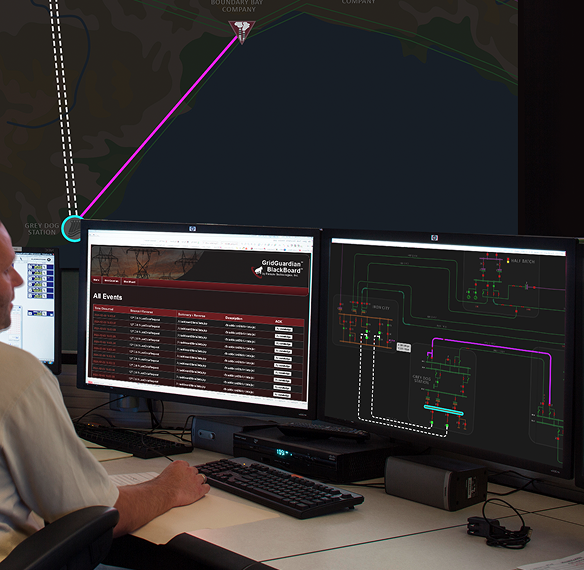
Person monitoring GridGuardian BlackBoard event and network flow displayed on dual computer screens at a control station.

High-Availability Architecture

Primate is deployed with redundant servers, mirrored displays, and automatic failover across the visualization layer. When a node goes down, operators see no interruption. 

The display continues rendering, alerts continue firing, and the underlying handoff is invisible to the people running the system. Resilience is built into the platform, not bolted on through manual procedures that only work if someone remembers them at 3 a.m.

Real-Time System Health Monitoring

Primate continuously monitors the health of every upstream system: SCADA, EMS, OMS, historian, GIS, and security feeds, and surfaces subsystem failures the moment they occur. 

Alarm processor down? Feed gone stale? Server load spiking? Operators see it immediately, on the same display they use to run the system. This is the failure-inside-the-failure that turns manageable events into reportable ones, and Primate makes it impossible to miss.

Performance-Driven Display Technology

Primate is powered by four core technologies that work together to deliver fast, reliable, and distortion-free visualization for control rooms.

GridGuardian™

Mission-Critical Data Engine

GridGuardian™ is an advanced data aggregation platform that consolidates and processes real-time control room data into actionable intelligence for enhanced situational awareness and decision-making.

Learn More
Control room operator using GridGuardian software to monitor real-time system data and alerts

TileViewer

Display Without Boundaries

TileViewer enables secure, multi-platform access to critical control room displays, ensuring consistent visualization from video walls to mobile devices. 

Learn More
Woman looking at desktop computer screen with product screenshot

BlackBoard™

Display Without Limits

BlackBoard™ delivers crystal-clear visualization of control room data across multiple displays while maintaining precision and eliminating distortion at any scale.

Learn More
Control room operator using BlackBoard for real-time system visualization across multiple displays

TileBuilder

Lightning-Fast Rendering

TileBuilder accelerates visualization of complex control room data through advanced rendering technology, delivering instant, real-time display updates.

Learn More
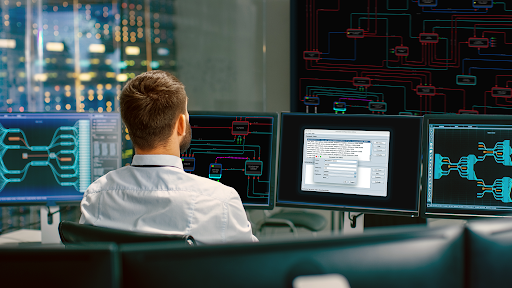
Operator using TileBuilder for real-time rendering of complex control room data on multiple monitors

Discover Primate’s operational resilience software

Black Start & System Restoration Visibility

Restoring a system after a major outage is one of the highest-stakes workflows in any control room, and most platforms were never designed to support it. 

Primate provides full system restoration visibility: phased re-energization tracking, configuration state across the recovery sequence, and clear operator handoffs as the system comes back online. The same platform that runs daily operations runs the restoration, with no gap in continuity or context.

Display Continuity Under Degraded Conditions

When source systems degrade, most displays either freeze or show stale data that looks current. Primate explicitly flags degraded feeds, missing data, and uncertain values directly on the operational display so operators always know what they can trust.

Primate’s vector-based rendering means the visual layer keeps performing even under heavy load, and TileViewer keeps remote stakeholders synchronized to the same authoritative view as the primary control room.

Person monitoring GridGuardian BlackBoard event and network flow displayed on dual computer screens at a control station.
Wind farm with overlaid data graphs, representing intelligent data processing and real-time analytics

Built for Operations That Can’t Afford Downtime

Primate's operational resilience software is designed for environments where a degraded control room is a public-facing event, a regulatory exposure, or a safety risk. Wherever continuity of awareness matters as much as continuity of operations, Primate is built to hold the line.

Build True Operational Resilience

Every control room performs well on a good day. The ones that hold up on the worst day are the ones built for it from the start. Primate's operational resilience software gives operators continuous visibility, validated data, and uninterrupted control through the events that actually test a system.

See how Primate keeps your control room running

Request a Demo

Frequently Asked
Questions

How is operational resilience different from disaster recovery?
Disaster recovery is what happens after an event: restoring systems, data, and operations from backup. Operational resilience is what happens during the event. Primate keeps operators in command while systems are degraded, failing, or recovering, so the operational picture never goes dark in the first place.
Does Primate replace our existing failover infrastructure?
No. Primate sits at the visualization and operational intelligence layer, complementing the redundancy you already have in your SCADA, EMS, and network infrastructure. It ensures operators retain visibility and context through the failover events your underlying systems are designed to handle.
How does the software perform during a major event or restoration?
Primate is engineered for the conditions most platforms are not tested under. During high-load events like large storms, cascading alarms, multi-region outages, vector-based rendering, intelligent alert tiering, and validated data feeds keep the display responsive and the information trustworthy.
Can it handle partial failures of upstream systems like SCADA or EMS?
Yes. Primate’s operational resilience software explicitly flags degraded or missing feeds on the operational display rather than silently passing through stale values. Operators always know what they can trust, which is the foundation of every correct decision under pressure.
Where does this operational resilience software run?
Primate runs on your own infrastructure with full redundancy options. Customers retain complete control over deployment topology, failover configuration, and integration with their existing high-availability environments.
Assessment Tool

Is your control room ready for AAR and DLR?

See if your control room is prepared to support AAR and DLR across visibility, data, and operations.

Check Readiness →