
Calculate what one control room event really costs | Try our free ROI calculator


Control rooms keep failing because of the seams between SCADA and EMS, between OMS and GIS, between the video wall and the operator's desktop. Primate's integrated control room software brings every operational system, every display surface, and every stakeholder into one real-time view, so the picture operators rely on is always whole.


The typical control room runs ten or more operational systems. Each one was selected for a reason, each one does its job, and each one shows a different version of the same operation. Operators spend their attention stitching those versions together in real time, while the actual job — running the system — competes for the same focus.
Most platforms marketed as "integrated" only display these systems side by side. But that is aggregation, not integration.
Primate is built for the operational layer underneath: one validated data model, one logic engine, one synchronized view across every surface the control room uses.

.jpg)
Primate connects to the full range of systems that drive a modern control room: SCADA, EMS, OMS, GIS, historian platforms, security systems, weather feeds, and enterprise applications, and brings them into a single, validated operational stream.
What sets Primate apart is what happens after the data arrives. Different protocols, refresh cycles, naming conventions, and data structures are normalized at the platform layer, so a single asset shows up the same way.
Operators stop reconciling names, IDs, and statuses across systems and start working from one authoritative reference for every piece of infrastructure they are responsible for.


Primate is powered by four core technologies that work together to deliver fast, reliable, and distortion-free visualization for control rooms.
Mission-Critical Data Engine
GridGuardian™ is an advanced data aggregation platform that consolidates and processes real-time control room data into actionable intelligence for enhanced situational awareness and decision-making.
Learn More
Display Without Boundaries
TileViewer enables secure, multi-platform access to critical control room displays, ensuring consistent visualization from video walls to mobile devices.
Learn More
Display Without Limits
BlackBoard™ delivers crystal-clear visualization of control room data across multiple displays while maintaining precision and eliminating distortion at any scale.
Learn More.avif)
Lightning-Fast Rendering
TileBuilder accelerates visualization of complex control room data through advanced rendering technology, delivering instant, real-time display updates.
Learn More
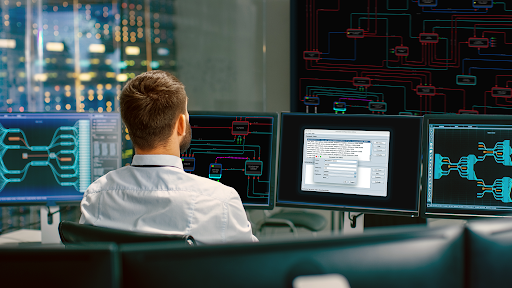
Primate runs operational logic across the integrated data: correlating events between SCADA and OMS, validating outage records against GIS asset state, flagging anomalies, and computing derived values that no source system produces on its own.
This is the layer where Primate stops being a viewer and starts being a platform.
Moreover, Primate’s integrated control room software also correlates related events across systems, suppresses known cascade patterns, and surfaces the root condition. That means no more alarm overload, ever again.
Integration has to extend past the data layer. Primate delivers the same real-time view to every surface the operation depends on: video walls, operator workstations, supervisor desktops, and authorized remote access, so every stakeholder works from the same operational truth, with role-appropriate detail.
This matters most during major events. When an operator, a supervisor, and a remote responder are all looking at the same authoritative view instead of three partial ones, coordination holds. Primate makes that the default state, not the exception.


Primate's integrated control room software is built for environments where the number of source systems has outgrown the team's ability to reconcile them manually. Wherever fragmented operational systems are the structural barrier to faster, safer decisions, Primate is built to dissolve them.

Electric utilities: SCADA, EMS, OMS, and GIS unified into one operational view
Transportation and rail: dispatch, asset health, and incident data on one surface
Manufacturing and industrial operations: process, equipment, and quality data consolidated
Emergency management: multi-agency systems fused into one shared picture
Critical infrastructure: operations where system sprawl is the bottleneck to response
The control rooms that perform under pressure are the ones where every operator is working from the same real-time picture. Primate's integrated control room software makes that the default state, not the exception. Built for the operations where fragmented systems can no longer be allowed to stand between your team and the right call.


See if your control room is prepared to support AAR and DLR across visibility, data, and operations.
Check Readiness →